Did you know that synagogues using donor management systems see an average 35% increase in repeat giving? Yet most congregations are still tracking donors with spreadsheets and handwritten notes! If you’re struggling to remember who donated last year or which members attend your events regularly, you’re leaving money on the table. Synagogue fundraising software changes everything. It transforms scattered information into actionable insights that help you build deeper relationships with your community. I’ve seen firsthand how the right tools turn fundraising from a chaotic scramble into a strategic process. No more lost donor cards or forgotten follow-ups. Just meaningful connections that translate into sustained support for your shul’s mission.
Understanding CRM Technology for Jewish Congregations
Look, I’ll be honest with you. When someone first mentioned CRM to me in the context of synagogue operations, I thought they were speaking another language entirely. Customer Relationship Management? We’re not selling widgets here!
But here’s the thing—once you get past that corporate-sounding name, you realize that a CRM is really just a smart way to keep track of the people who make your shul what it is. Think of it as your congregation’s memory bank, but one that actually remembers everything perfectly (unlike that filing cabinet in the office that nobody’s organized since 1987).
So what makes a CRM different from the Excel spreadsheet your treasurer has been updating for the past decade? Everything, really. While spreadsheets are great for lists, they’re absolutely terrible at showing you the full picture of your members’ involvement. A proper synagogue fundraising software system connects all the dots—donations, event attendance, volunteer hours, yahrzeit dates, that time someone called the rabbi at midnight with a question about kashrut. It’s all there, accessible, and actually useful.
The features you really need? Integration is huge. Your CRM should talk to your accounting software, your email system, your event management tools. Cloud-based solutions usually make more sense for most shuls because, let’s face it, nobody wants to deal with maintaining servers in the coat closet. And data security? Non-negotiable. You’re dealing with sensitive financial information, personal details, and family dynamics that absolutely must stay protected.
Building a Comprehensive Donor Database That Actually Works
Here’s where the magic happens—or where everything falls apart if you do it wrong.
Your donor database needs to be the single source of truth for your congregation. No more hunting through three different spreadsheets, a shoebox of index cards, and someone’s personal notebook to figure out who donated what and when. Everything goes in one place, and everyone who needs access can actually find what they’re looking for.
But what information should you track? Start with the basics: giving history, obviously. But don’t stop there! Event attendance tells you who’s engaged even when they’re not writing checks. Volunteer participation shows commitment. Yahrzeit dates—absolutely critical for both pastoral care and fundraising opportunities. Family relationships matter too, because understanding household dynamics helps you avoid awkward situations like asking both divorced parents to chair the same committee.
The import process can be a nightmare if you’re not careful. You’ve probably got data scattered across multiple sources—old databases, spreadsheets, even paper records. Take your time with this. Rushing the data migration is like building a house on a cracked foundation. It’ll come back to haunt you.
And please, for the love of all that is holy, establish data hygiene practices from day one. Assign someone to regularly clean up duplicate entries, update addresses, and remove outdated information. A dirty database is worse than no database at all because you’ll make decisions based on garbage information.
Segmentation is where things get interesting. Group your congregation by engagement level, giving capacity, age, interests, lifecycle stage. The young families have different needs and giving patterns than your longtime members. Your major donors require different communication than first-time contributors. ShulHub’s platform makes this kind of segmentation actually manageable, which is kind of a game-changer when you’re used to doing everything manually.
Personalizing Your Fundraising Appeals for Maximum Impact
You know what doesn’t work? Sending the exact same appeal letter to everyone and hoping for the best. It’s lazy, it’s ineffective, and honestly, it’s a bit insulting to people who’ve been supporting your shul for decades.
Your donor history tells a story. Someone who’s given $1,800 annually for the past five years probably shouldn’t get an ask for $100. That’s leaving money on the table! Similarly, asking a first-time attendee for a major gift is just awkward for everyone involved.
Segment your campaigns by what makes sense. High Holiday appeals should look different from building campaign asks. Young professional outreach shouldn’t sound like you’re writing to the sisterhood (no offense to the sisterhood—they’re wonderful, but they’re a different audience). Reference specific involvement when you can: “We noticed you attended our Tu B’Shvat seder” hits differently than “Dear Member.”
Lapsed donors need special attention. They stopped giving for a reason—maybe life got busy, maybe they felt disconnected, maybe nobody thanked them properly last time. A well-crafted re-engagement campaign acknowledges the gap without making them feel guilty and gives them a reason to reconnect.
And timing matters more than you think. Don’t ask someone for a donation the week after they lost a parent. Do reach out around anniversaries of major lifecycle events or during meaningful times in the Jewish calendar when people are already thinking about their relationship with the community.
Automating Communication Without Losing the Personal Touch
Automation gets a bad rap, and honestly, sometimes it deserves it. We’ve all received those clearly automated emails that feel about as warm as a frozen bagel.
But done right? Automation is your secret weapon.
Set up thank-you sequences that trigger immediately after a donation. Not next week when someone gets around to it—immediately. But make them feel genuine! “Thank you for your generous gift” sounds robotic. “Your support of our religious school program means Mrs. Goldberg can finally replace those prayer books from 1973” sounds human.
Birthday and yahrzeit acknowledgments should absolutely be automated because you’ll forget otherwise. I don’t care how organized you are—something will slip through. But the automation should enable personal follow-up, not replace it. The rabbi adding a handwritten note to an automated card? Perfect.
Drip campaigns for new members work beautifully when they’re thoughtfully designed. Welcome them, introduce them to programs gradually, invite them to get involved. Just don’t overwhelm people with seventeen emails in their first week. Nobody likes that.
The key is balancing efficiency with authenticity. Let automation handle the scheduling and basic content, but leave room for personalization. Use merge fields that actually make sense. And for the truly important communications? The major donor thank-yous, the personal pastoral outreach, the sensitive conversations? Those should always come directly from a human being.
Email deliverability is boring but crucial. All the personalization in the world doesn’t matter if your emails land in spam folders. Keep your list clean, authenticate your domain, follow best practices. Your congregants can’t respond to messages they never see.
Tracking Donor Engagement Beyond Financial Contributions
Here’s something that took me way too long to understand: your best donors aren’t always your biggest donors. Sometimes they are! But the member who shows up for every Shabbat morning minyan, volunteers in the food pantry, and brings challah to homebound congregants might be your most valuable community asset even if their financial contributions are modest.
Track it all. Service attendance. Program participation. Committee involvement. Phone calls with clergy. That guy who fixes the Sukkah every year without being asked.
Why? Because engagement predicts future giving. The data consistently shows that people who are connected to your community in multiple ways give more, give more consistently, and stay involved longer. Someone who only writes a check once a year is much more likely to disappear than someone who’s there every week.
Create engagement scores if your synagogue fundraising software allows it. Weight different activities based on what matters to your community. High Holiday attendance might count for less than regular Shabbat participation. Volunteering for one-time events versus ongoing committee work. There’s no perfect formula, but having some systematic way to identify your most connected members is incredibly valuable.
This is also how you spot major donor prospects hiding in plain sight. That family who’s at everything, whose kids are in all the programs, who clearly has the financial capacity but gives modestly? They’re engaged. They love your shul. They just haven’t been asked properly or haven’t been shown how they could make a transformational impact.
Leveraging Data Analytics to Inform Fundraising Strategy
Numbers tell stories if you know how to listen to them.
Look at giving trends over time. Is overall giving up or down? Are you getting more small donors or fewer large ones? Are certain campaigns consistently outperforming others? This isn’t just interesting trivia—it’s actionable intelligence that should shape your strategy.
Your most loyal supporters are gold. They might not be your biggest givers, but consistency matters enormously. Someone who’s given $360 every year for twenty years has contributed over $7,000 and will likely continue. They deserve recognition and cultivation, not just generic thank-yous.
Campaign performance metrics help you stop doing what doesn’t work and double down on what does. If your direct mail appeals generate responses from 3% of recipients but your personalized video messages get 15% engagement, what should you do more of? The data tells you, if you’re paying attention.
Revenue forecasting becomes possible when you have historical data. You can project with reasonable accuracy what your annual fund will raise, when donations typically come in, what your baseline is versus stretch goals. This helps leadership plan budgets and programs with confidence instead of crossing their fingers and hoping.
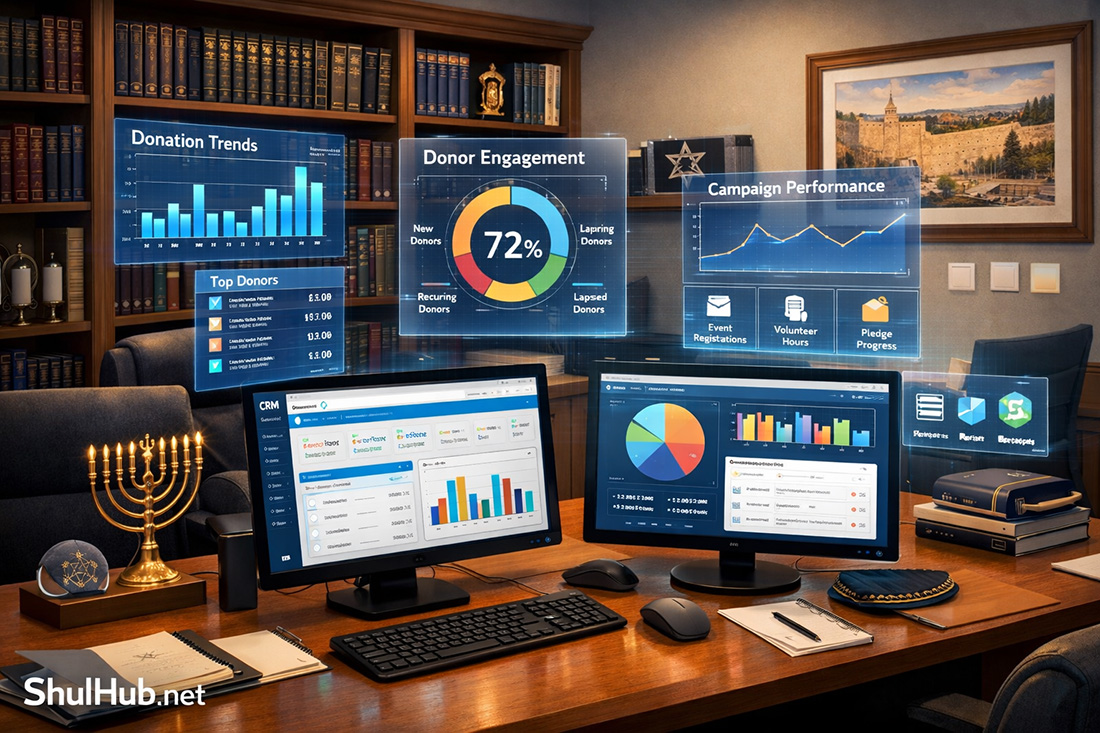
Creating dashboards for leadership turns abstract data into visual, comprehensible insights. Board members don’t need to understand SQL queries or complex spreadsheets. They need to see at a glance whether you’re tracking toward goals, which segments are giving, and where opportunities exist.
ShulHub integrates analytics in ways that actually make sense for congregations, showing you the metrics that matter without drowning you in irrelevant data points.
Streamlining Event Management and Registration Processes
Events are where fundraising happens, whether that’s explicitly (like galas) or implicitly (like programs that deepen engagement and lead to future giving).
When someone registers for an event, that information should automatically flow into their donor record. No manual data entry, no paper lists that get lost, no wondering who actually showed up versus who just registered. Integration is everything here.
For major fundraising events—galas, annual dinners, concerts—you need systems that handle the complexity. Table assignments. Auction bids. Sponsorship levels. Payment processing. Communication workflows that remind people to register, confirm their attendance, thank them afterward, and report on impact.
But here’s what people forget: every event is a prospecting opportunity. Someone brings a guest who’s not currently a member? Capture that information! They liked your community enough to spend an evening there. Follow up thoughtfully, invite them back, nurture that relationship. Your next major donor might walk through the door as someone’s plus-one at a Purim party.
Event ROI matters too. Which programs generate net revenue? Which ones lose money but drive engagement? Which ones do both? You can’t answer these questions without proper tracking, and you can’t make smart decisions about what to continue, modify, or discontinue without understanding the full picture.
Implementing Recurring Giving Programs That Build Sustainable Revenue
Want to know the secret to predictable revenue? Monthly donors.
Seriously. Recurring giving programs transform fundraising from an annual panic into sustainable, reliable income. A member who gives $1,800 once a year might not think twice about $150 monthly. It’s the same amount, but the psychology is completely different, and for your cash flow, it’s transformative.
Set up automated monthly giving options that are genuinely easy to use. The fewer clicks between intention and action, the better. Create special recognition for sustained giving society members—people like belonging to something that feels exclusive and meaningful.
Communicate impact consistently. Monthly donors need to be reminded that their ongoing support matters, that it’s making a difference, that you notice and appreciate their commitment. Don’t just thank them once and forget about them.
The administrative burden drops dramatically when donations process automatically. No more manual entry of twelve separate checks from the same person. No more wondering if someone forgot to give this year. The system handles it, freeing up staff time for relationship-building instead of data entry.
Of course, payment methods fail. Cards expire, accounts close, things happen. Your system needs to automatically notify donors when payments don’t process and make it easy to update information. Otherwise, you’ll lose recurring donors to simple technical issues that could have been resolved with a single email.
Growing your recurring donor base requires targeted campaigns. Identify annual donors who might be open to converting. Show them the benefits. Make it compelling. Even modest success here pays massive dividends over time.
Generating Meaningful Reports for Leadership and Board Members
Reports are where your carefully maintained data either proves its value or reveals that you’ve been tracking the wrong things.
Custom reports should answer specific questions: Who are our major donor prospects? What’s our donor retention rate? How effective was our last campaign? Which board members have followed through on their giving commitments? (Yes, that last one can be awkward, but it’s necessary.)
End-of-year tax statements have to be accurate and timely. Mess this up and you’ll hear about it. Automation makes this infinitely easier, but you still need to review for accuracy before sending.
Progress-to-goal dashboards keep campaign committees motivated and informed. When everyone can see where you are relative to the target, it creates urgency and momentum. Transparency drives action.
Skeptical board members need ROI demonstrations. Show them what you invested in fundraising efforts and what you generated in return. Show them how donor retention improved. Show them that your synagogue fundraising software investment is paying for itself multiple times over. Data converts skeptics.
Prospect research reports inform major gift conversations. Before approaching someone about a significant contribution, you want to know their giving history, their engagement patterns, their family situation, their capacity indicators. Good reports compile this information efficiently so development staff and lay leaders can have informed, strategic conversations.
Export capabilities matter for external requirements—audits, grant applications, denominational reporting. Your system should make it easy to extract data in formats that other people can actually use.
Training Staff and Volunteers to Maximize Your CRM Investment
You can have the most sophisticated system in the world, but if nobody uses it properly, you’ve accomplished nothing.
User adoption is where most CRM implementations succeed or fail. People resist change. They’re comfortable with the old way, even if the old way is objectively terrible. You need strategies to overcome this resistance, not just expect everyone to enthusiastically embrace new technology.
Role-based access helps. The development director needs different permissions than a volunteer coordinator. The rabbi shouldn’t see detailed financial data they don’t need, and the bookkeeper doesn’t need access to pastoral counseling notes. Appropriate access reduces overwhelm and protects privacy.
Data entry protocols ensure consistency. If three different people enter phone numbers three different ways, your system becomes a mess. Establish standards and document them clearly. Make them simple enough that people will actually follow them.
Regular training sessions matter more than you think. One introductory session isn’t enough. People forget, features get added, new staff join. Schedule quarterly refreshers, create video tutorials, write documentation that’s actually helpful rather than technically precise but incomprehensible.
CRM champions—enthusiastic users who help others and advocate for adoption—are worth their weight in gold. Identify them early, empower them, and let them spread enthusiasm organically.
Measure adoption rates. Who’s actually logging in? What features are being used? Where are people struggling? You can’t fix problems you don’t know exist, and low adoption usually signals specific barriers that can be addressed with targeted support.
Integrating Your CRM with Other Essential Synagogue Tools
Integration is where your synagogue fundraising software stops being a nice tool and becomes a complete ecosystem.
Online donation platforms need to feed directly into your CRM. Someone gives through your website at midnight? That should be in your database immediately, not whenever someone remembers to manually enter it. Payment processor integration ensures every transaction is recorded accurately without manual intervention.
Email marketing service connections let you segment sophisticated campaigns based on CRM data, then track results back into individual records. Who opened your email? Who clicked? Who donated in response? This closed-loop tracking makes you exponentially smarter about what works.
Accounting software integration reconciles financial data automatically. Your development records match your financial records because they’re pulling from the same source. No more discrepancies, no more painful reconciliation processes at year-end.
Membership management and fundraising can’t be separate silos. They’re fundamentally connected, and your systems should reflect that reality.
Website forms—event registrations, volunteer sign-ups, contact requests—should create or update records in your CRM automatically. Every interaction someone has with your organization should be captured without requiring staff to manually enter information.
The goal is seamless data flow between systems. Information enters once and propagates everywhere it needs to go. This eliminates duplicate entry, reduces errors, and saves enormous amounts of staff time that can be redirected toward relationship-building.
Overcoming Common Implementation Challenges and Pitfalls
Let’s be real: implementing new systems is hard, and anyone who tells you otherwise is selling something.
Staff resistance is normal and predictable. People who’ve done things a certain way for years don’t want to learn something new, especially if they feel like the old way worked fine. You need to address this with empathy while still maintaining momentum. Show them how the new system makes their lives easier, not harder. Get them involved in decision-making. Address concerns directly.
Data migration is where implementations often go sideways. Moving information from legacy systems without losing data or introducing errors requires careful planning and usually professional help. Don’t underestimate this. Budget time and money accordingly.
Timelines matter. Rushing implementation leads to mistakes and frustrated users. But dragging it out forever means people lose interest and nothing actually changes. Find the balance—ambitious but realistic.
Budget for both software costs and staff time. The software subscription is the easy part. Training, migration, customization, and ongoing administration require significant staff investment. Under-resourcing implementation is setting yourself up for failure.
Avoid the customization trap. Yes, you can configure most systems extensively. No, you shouldn’t go crazy with it right away. Start with standard features, learn what you actually need versus what you think you need, then customize gradually based on real experience.
Learn from other congregations. They’ve already made mistakes you can avoid. Ask around in your network, join user groups, attend webinars. The Jewish community is generally generous about sharing lessons learned, and there’s no reason to reinvent wheels that are already rolling nicely elsewhere.
The bottom line? Implementing synagogue fundraising software is a journey, not a destination. You’ll make mistakes, you’ll learn, you’ll adjust. But with thoughtful planning, adequate resources, and realistic expectations, you’ll end up with systems that transform how your congregation operates and dramatically improve your fundraising effectiveness. And really, isn’t that worth the effort?
Implementing a CRM system isn’t just about adopting new technology—it’s about transforming how your synagogue builds relationships with the very people who sustain it. When you centralize donor information, personalize your outreach, and make data-driven decisions, you’re not working harder; you’re working smarter! The synagogues thriving in 2026 are those that leverage technology to deepen human connections, not replace them. Your CRM should free up time previously spent on administrative tasks so you can focus on what really matters: meaningful conversations with donors about their values and your shared vision. Start small. Choose one or two features to implement first—maybe donor tracking and automated thank-you notes. Build confidence with quick wins, then expand. Your congregation deserves fundraising systems that honor both your sacred mission and your donors’ generosity. Ready to transform your fundraising efforts? The right CRM isn’t an expense—it’s an investment in your synagogue’s future. Take the first step today.